MWK foundations · Position + contacts + stack
The Stacking Guide
Ribs over pelvis. Crown over ribs. Find your contacts, organize your chassis, and keep enough freedom to move.
The MWK cue
“Feel your base. Bring your ribs over your pelvis. Let your crown float over your ribs. Keep your eyes easy.”
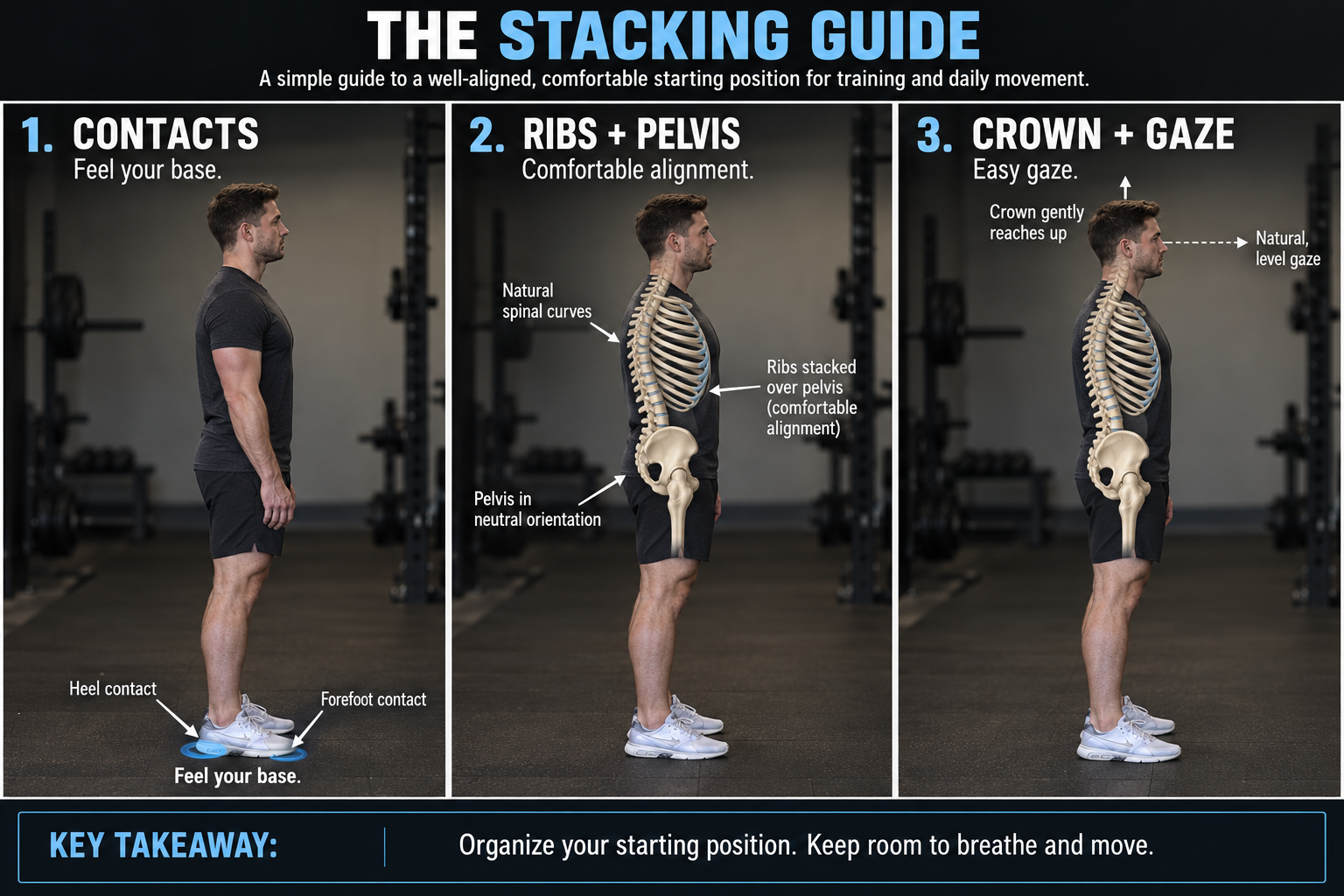
Use this as an upright starting reference. Find a position the person can own with less effort; keep natural spinal curves and avoid forcing every landmark onto a vertical line.
01 / Contacts: find your base
In standing, notice the heel, big-toe base, and little-toe base. Let the knees remain available rather than deliberately locking them backward. In sitting, use the seat and supported feet.
Say it
“Feel the floor under you. Let your base carry you.”
Look for
Repeatable contact without gripping the toes or shifting all the pressure into the heels.
02 / Pelvis: establish the base of the stack
Find a comfortable pelvic position over your support. If the person is hanging far forward or back, try a small shift and compare the effort. Avoid demanding a hard tuck, glute squeeze, or exaggerated arch.
Say it
“Let your pelvis settle over your base.”
Look for
A position that leaves the hips and knees free to move rather than rigidly held.
03 / Ribs: organize over the pelvis
Invite the rib cage to settle over the pelvis without collapsing the chest. A comfortable, unforced exhale can be a cue to explore this relationship. Allow the next inhale without deliberately lifting the chest or pinning the ribs down.
Say it
“Bring the ribs home over the pelvis. Keep room to breathe.”
Look for
Less unnecessary bracing and a repeatable starting position. Do not equate a visible rib angle with a diagnosis.
04 / Crown: organize over the ribs
Think of the crown as the top of the head. Let it float upward from the rib cage while the gaze stays comfortable. Use a small adjustment; avoid pulling the chin hard backward or flattening the neck.
Say it
“Crown over ribs. Eyes easy. Jaw soft.”
Look for
The head following the torso without a forced chin tuck, lifted chin, or rigid neck.
05 / Pressure control: keep it usable
At this low-effort setup stage, take two or three comfortable breaths. Keep contact with your base while allowing the ribs to move. If the cue makes breathing harder or requires a maximal brace, reduce the correction or add support.
Breathing and bracing demands change with load and task. This easy setup check is not a rule to stay relaxed or exhale through every heavy repetition.
06 / Move, then retest
Try a small reach, shallow squat, or hinge. Compare effort, balance, breathing comfort, and how easily the starting position returns. Keep the cue when it helps the task; change it when it adds tension.
Starting movement / effort:
One stacking cue:
Response after moving:
Keep / modify / remove:
The stack travels with the movement.
“Over” describes the upright reference. In a hinge, the pelvis and rib cage tip with the task and the head follows the torso. In a push-up, the body is inclined. In rotation, the segments can turn relative to one another. A useful stack allows the intended movement.
See the stack in every pattern
Follow the hips and shoulder blades through each exercise. The stack adapts to the task: some joints create motion while others support the position.
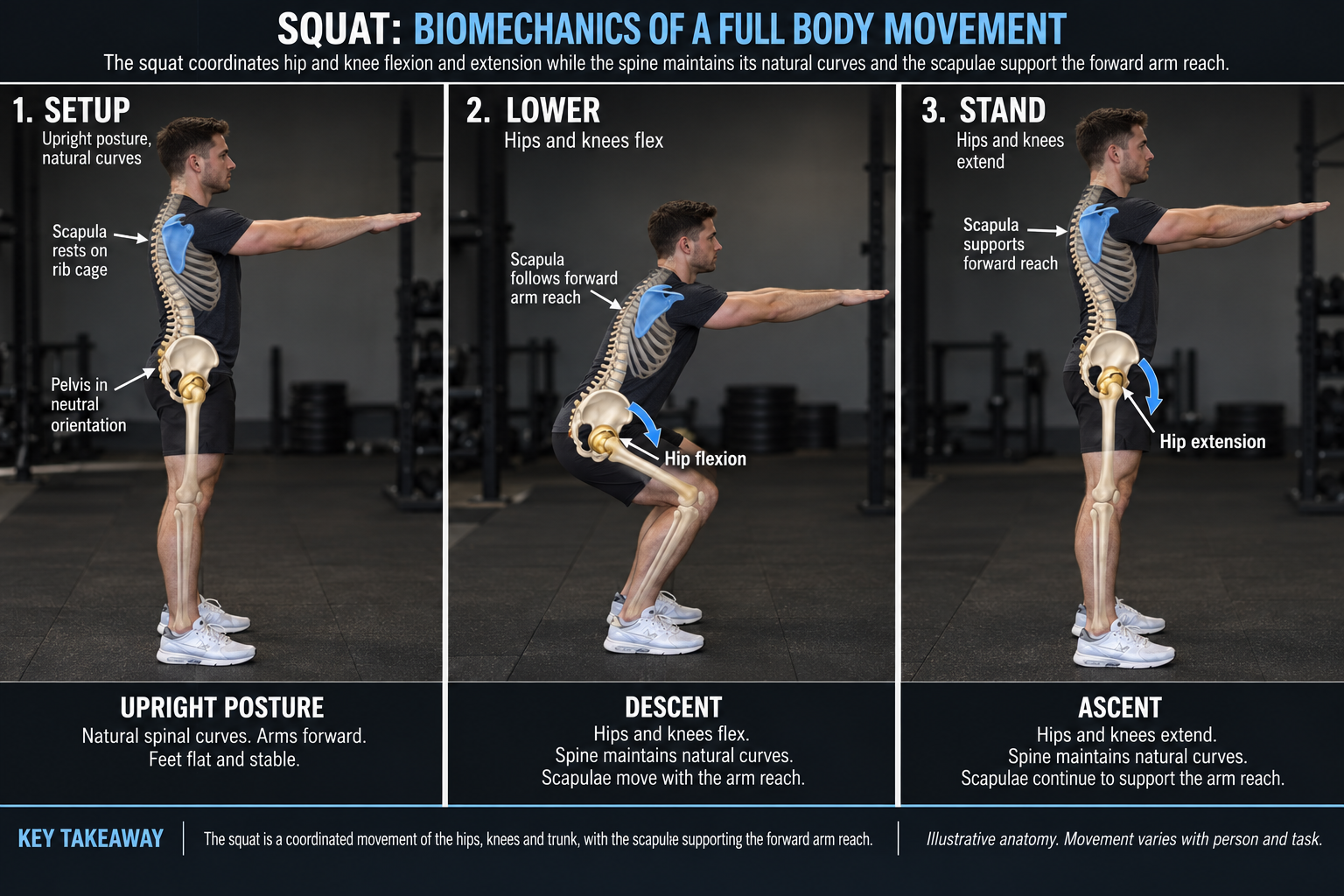 Squat
Explore the hip and scapular mechanics, stage by stage.
Open the illustrated guide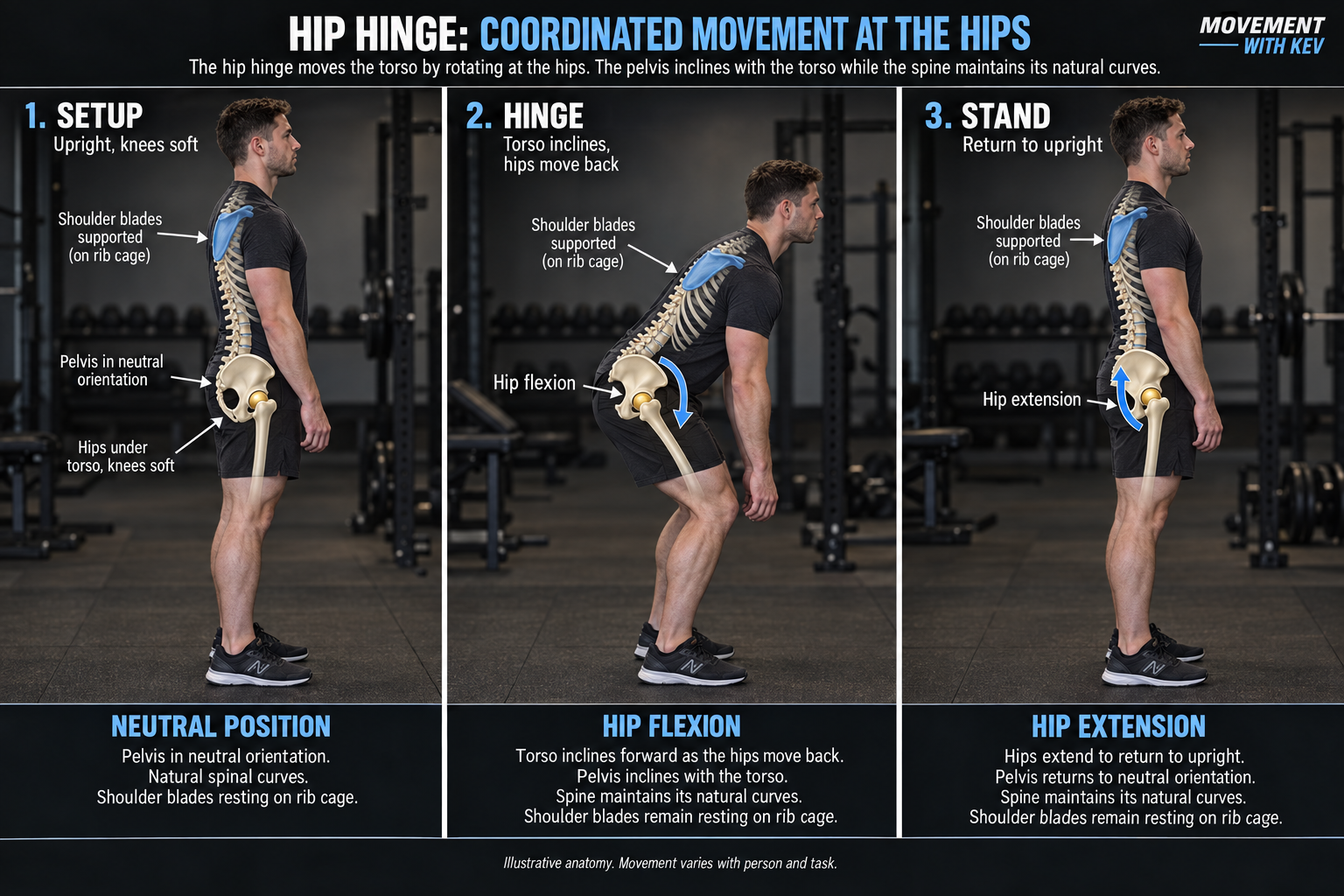 Hip hinge
Explore the hip and scapular mechanics, stage by stage.
Open the illustrated guide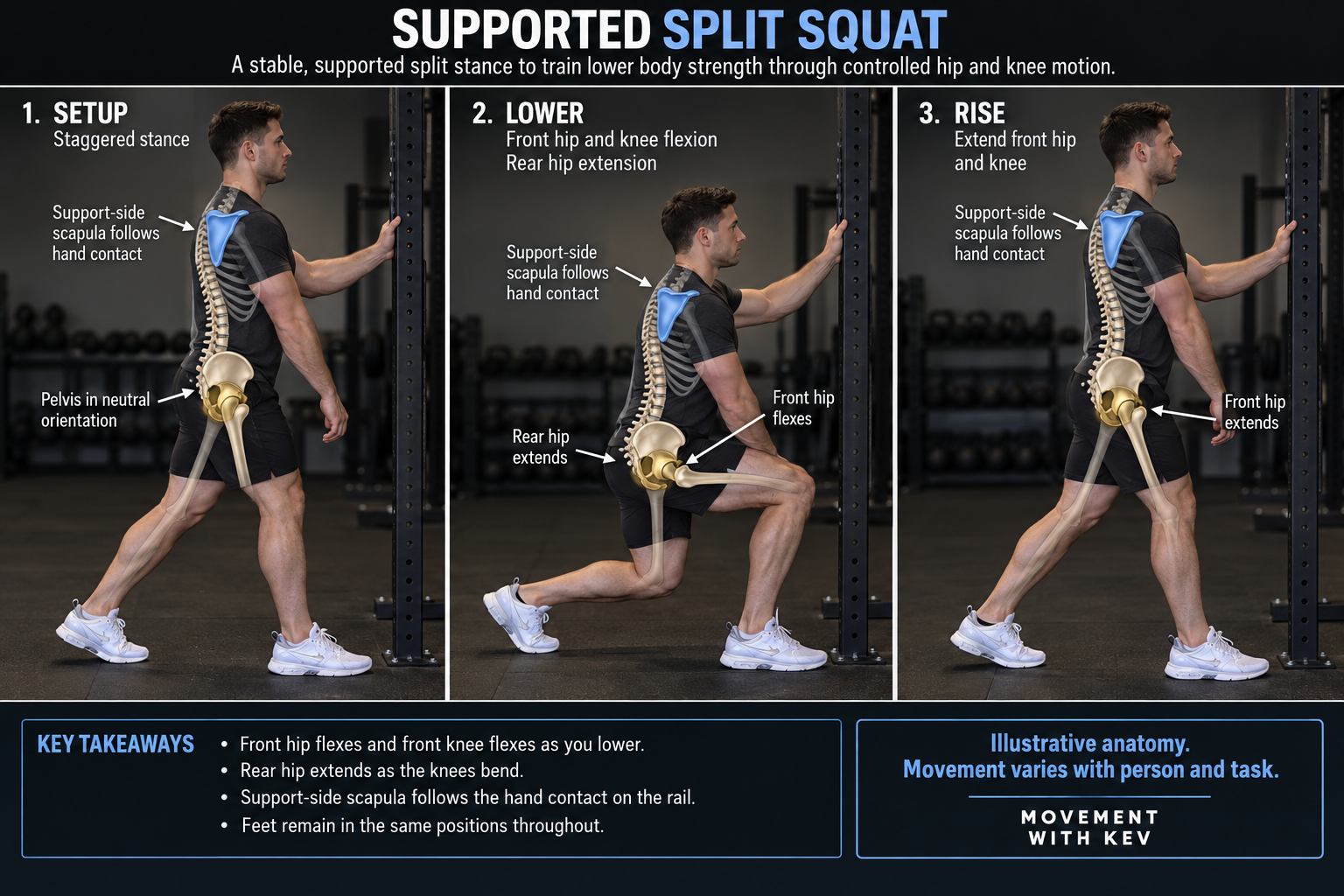 Supported split squat
Explore the hip and scapular mechanics, stage by stage.
Open the illustrated guide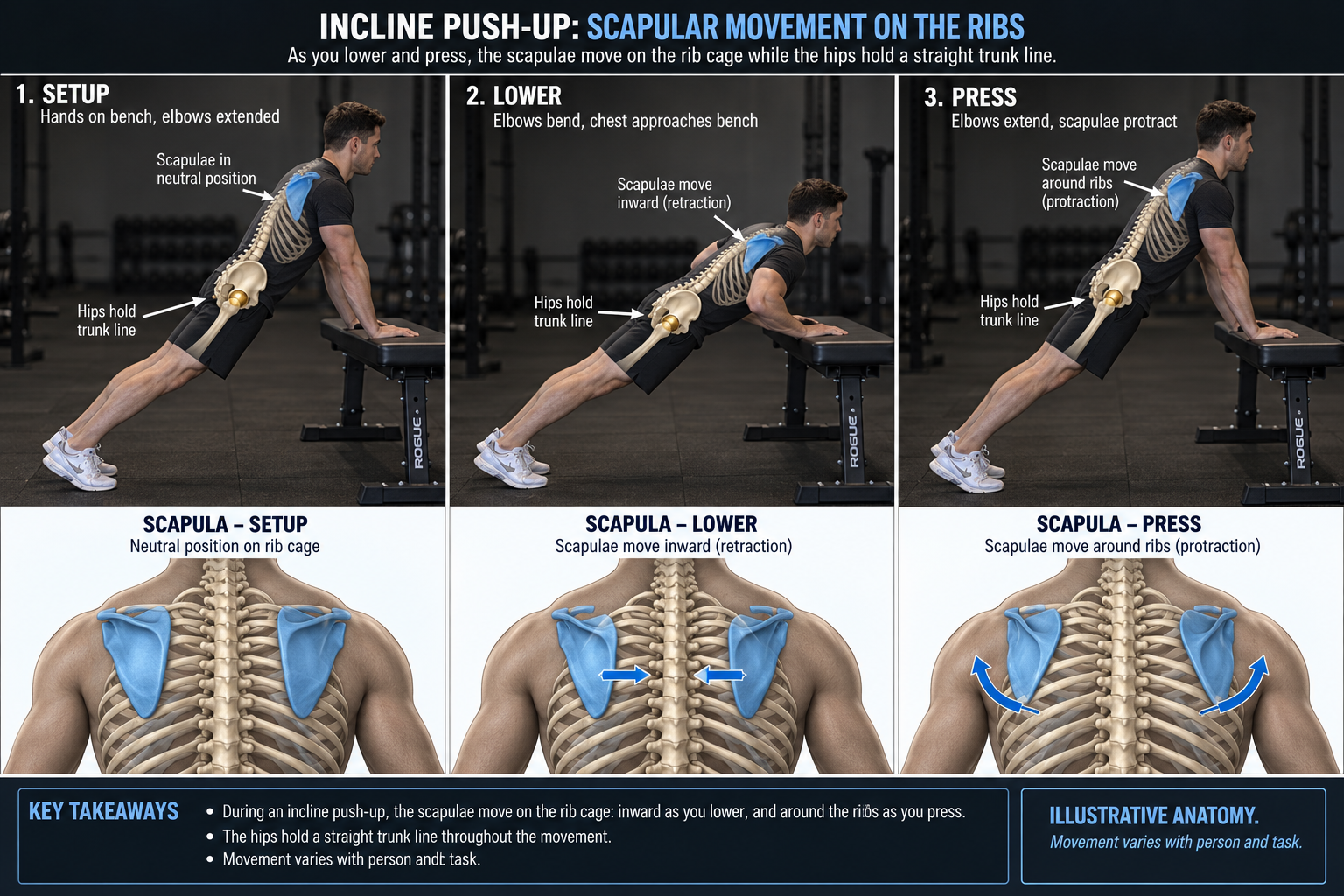 Incline push-up
Explore the hip and scapular mechanics, stage by stage.
Open the illustrated guide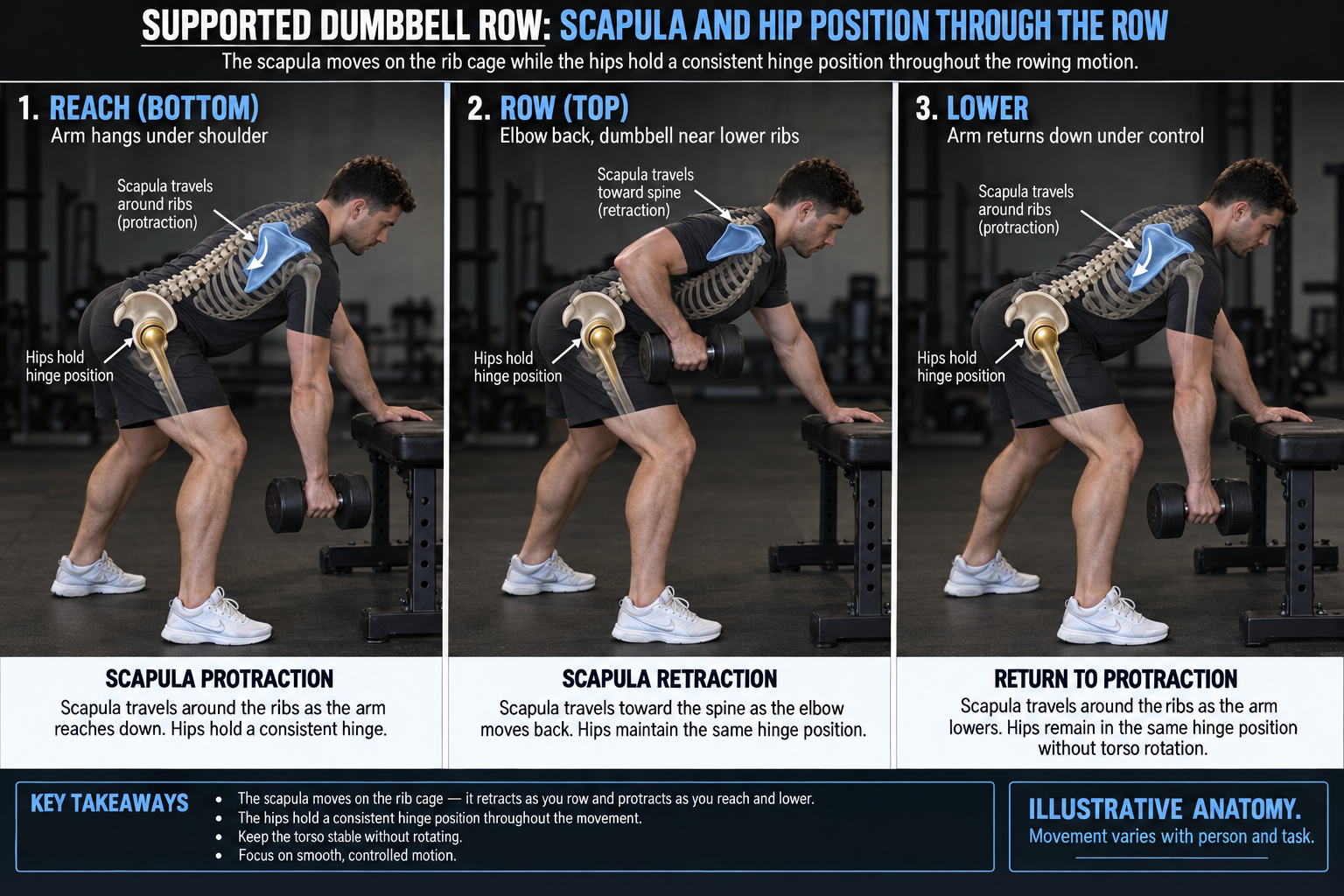 Supported dumbbell row
Explore the hip and scapular mechanics, stage by stage.
Open the illustrated guide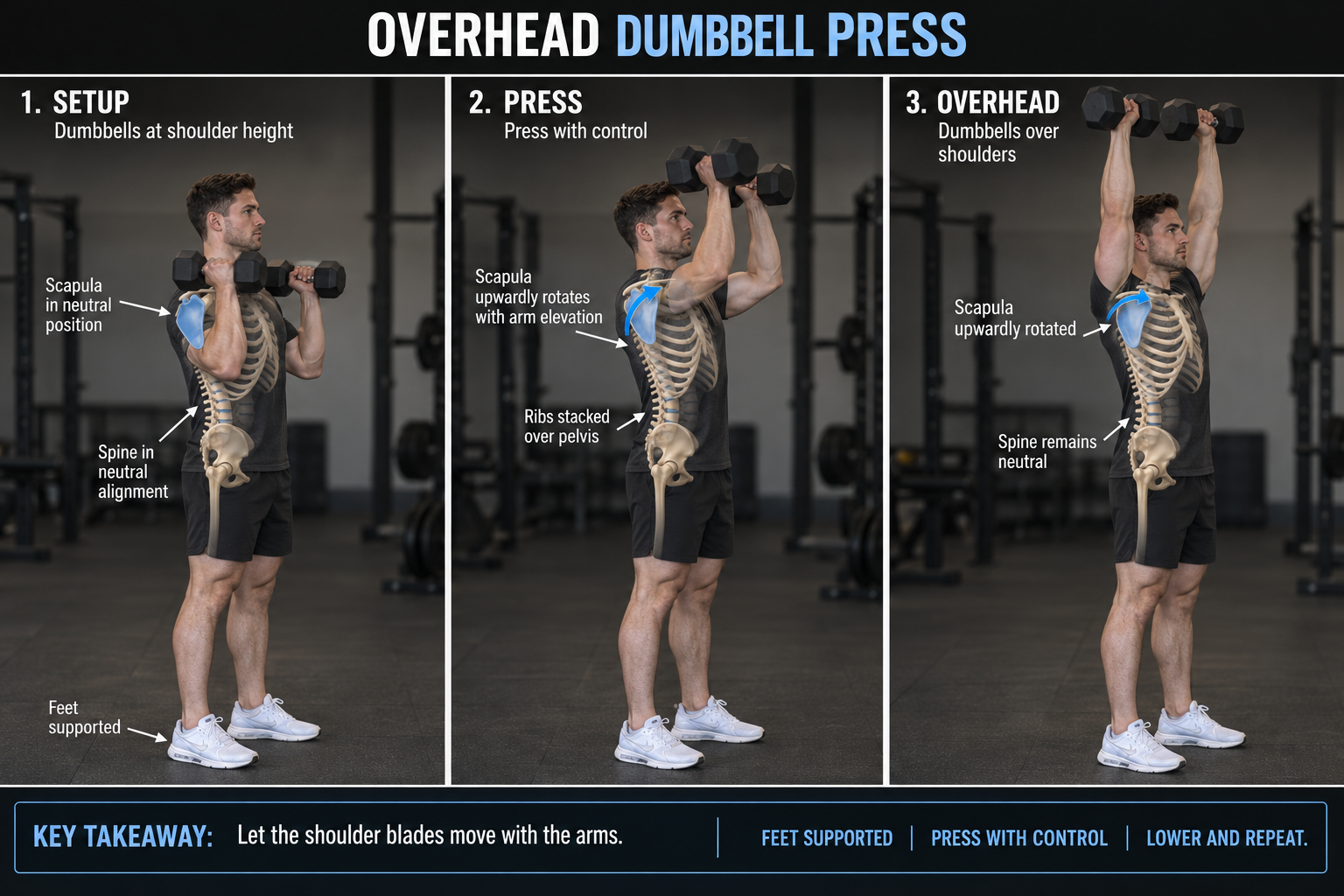 Overhead dumbbell press
Explore the hip and scapular mechanics, stage by stage.
Open the illustrated guideWhen the cue becomes too much
| If you see… | Try this cue |
|---|---|
| Hard pelvic tuck or glute clench | “Use less effort. Let your pelvis settle.” |
| Chest collapsed to get the ribs down | “Let the crown float; keep room through the chest.” |
| Rigid chin tuck or neck tension | “Make the head adjustment smaller. Let the eyes rest.” |
| Toe gripping or weight forced backward | “Reconnect the whole foot.” |
| Breath held during an easy setup | “Soften the effort or use a supported position.” |
Connect the framework
Explore original MWK diagrams and check your understanding
MWK coaching language and observation framework. These cues are options to test, not a universal posture standard or a diagnosis. Use a comfortable range; stop an adjustment that brings on new or worsening symptoms.