Coordinate the arm and shoulder blade without chasing range.
See it. Then coach it.
The movement, step by step.
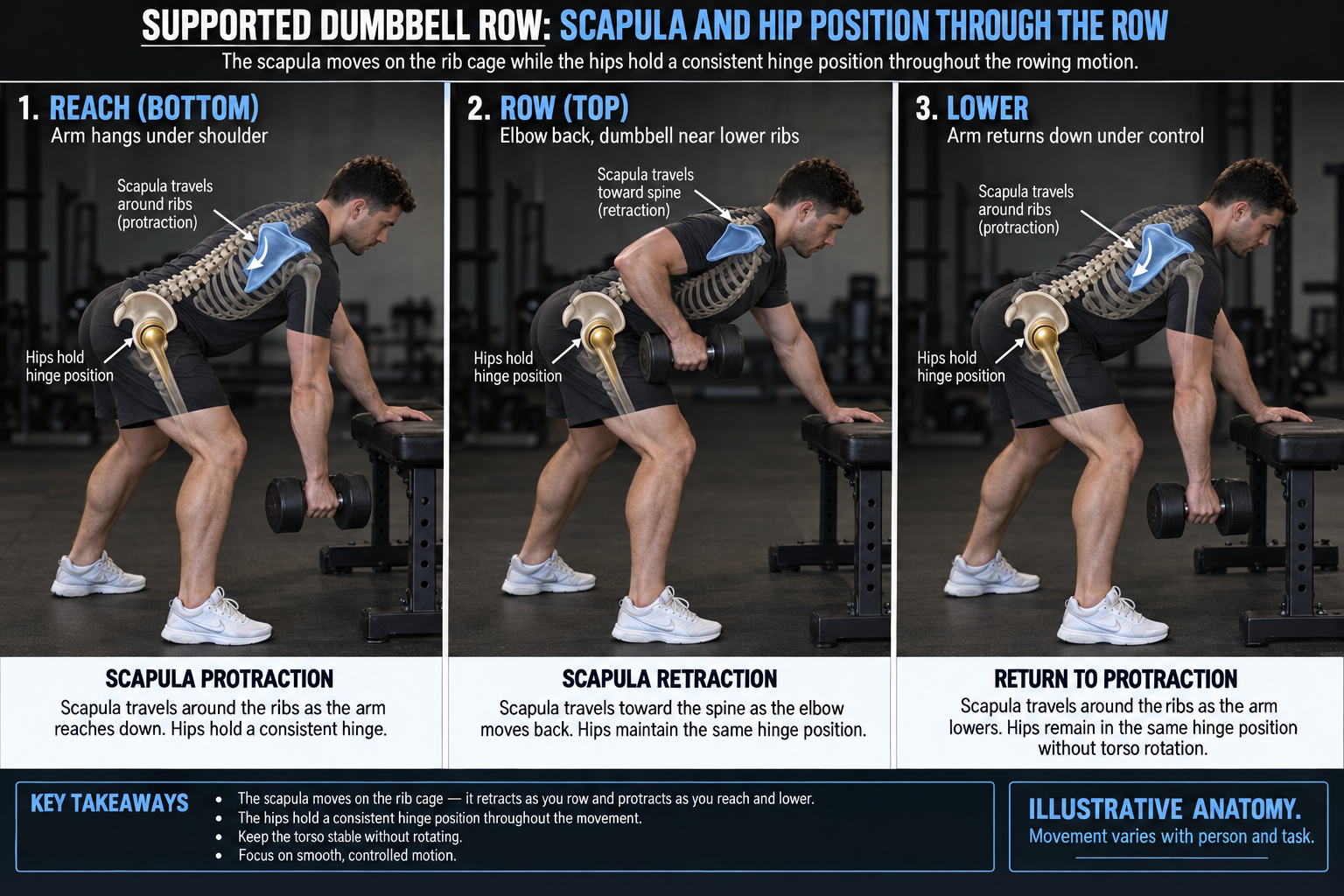
Ivory: rib cage and spine · Gold: hip region · Blue: shoulder-blade region. Illustrative overlays show movement relationships, not measured joint positions. Enlarge chart
Read the chart · hips + shoulder blades
What moves. What supports.
Scapula means shoulder blade. Flexion closes a joint angle; extension opens it. Protraction carries the shoulder blade around the ribs; retraction brings it toward the spine.
1. Support and reach
Hips / pelvis Hold a comfortable hip hinge with knees soft. The hips and trunk support the rowing position.
Scapula / arms The working scapula travels around the ribs as the arm reaches; the support-side scapula bears part of the body load.
2. Row
Hips / pelvis Hip angle remains relatively steady. Avoid rotating the whole trunk to create an apparent extra pull.
Scapula / arms Shoulder extension and elbow flexion draw the weight toward the ribs. The working scapula generally retract toward the spine, without forcing a maximal squeeze.
3. Lower
Hips / pelvis Maintain the hinge while lowering. Adjust support if holding the position distracts from the row.
Scapula / arms Elbow extension and the returning arm allow the scapula to protract around the ribs again. Control the reach instead of dropping the weight.
These are typical movement descriptions for the variation shown. A visible landmark does not reveal exact joint motion or establish a diagnosis. Use the chart to explain the task, then compare control and repeatability.
01 / Read the mechanics
The elbow flexes and the upper arm moves back in a row. Scapular retraction commonly accompanies the pull, followed by protraction as the arm reaches forward. Trunk rotation varies with the selected row.
A moving shoulder blade and a controlled rib cage can coexist. Pulling farther is not automatically better if extra travel comes only from an unintended trunk motion.
02 / Set up and coach
Choose chest or hand support if the hinge limits the row.
Let the arm reach forward under control.
Pull the elbow back to a comfortable endpoint; avoid forcing a pinch.
03 / Choose a variation
Chest-supported row
Reduce lower-body and balance demands.
One-arm supported row
Use the free hand to stabilize the setup.
Seated cable row
Practice a controlled reach and return.
04 / Fit it into the program
Use in a horizontal pulling slot. Preserve existing sets and effort while testing a change in support or grip.
For an initial comparison, change one feature and preserve the planned training volume where practical. Adjust load to the new variation; the same weight can represent a different demand.
05 / Observe and adjust
A forced shoulder-blade squeeze, a sudden forward shoulder glide, or unwanted trunk momentum are reasons to modify range or load. Some rotation is appropriate when deliberately programmed.
06 / Retest what matters
Compare at the same load, support, and reach. Note shoulder comfort and whether the intended endpoint is repeatable.
An immediate change is feedback, not proof of a correction. Check repeatability and the athlete’s response at the next session.
Movement education for coaches and athletes. These are general teaching examples, not an individualized rehabilitation plan. Stop a trial that produces new or worsening symptoms. MWK interpretation is labeled separately from the joint-action description.
Study basis: the supplied Week 9 lower-body exercise-selection notes, Week 10 upper-body exercise-selection notes, and MWK Scapular Mechanics & Reaches. Summarized for practical teaching; exercise responses vary by person and task.
Further reading: ACE rowing exercise research. The chart is a practical teaching summary for the pictured variation.