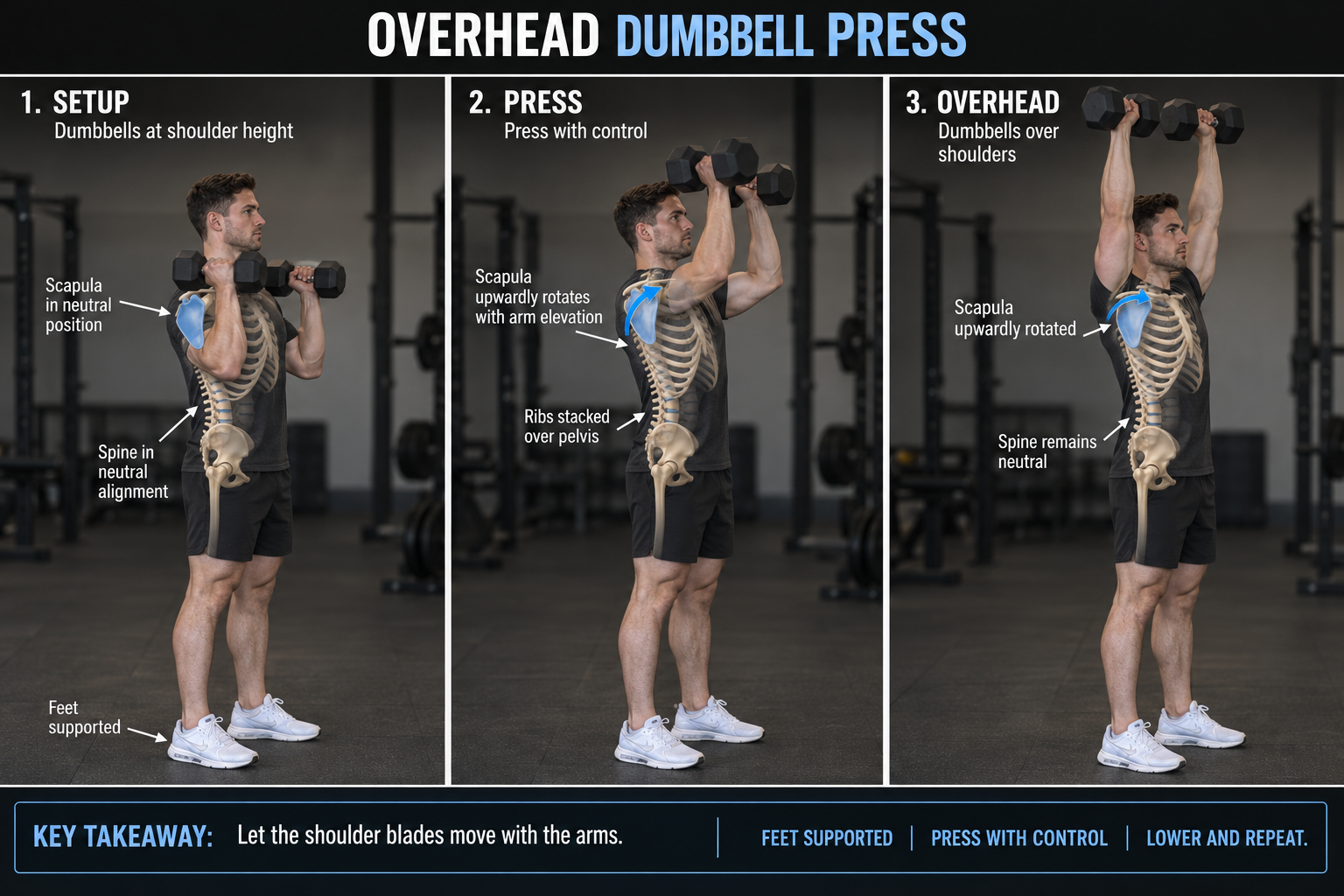
1. Set up
Support your feet and hold the dumbbells at shoulder height. Keep your wrists comfortable and forearms under the weights.
 MOVEMENT
Upper body · vertical press
Press overhead with control while allowing the shoulder blades to move.
See it. Then coach it.
Support your feet and hold the dumbbells at shoulder height. Keep your wrists comfortable and forearms under the weights.
Press upward along a comfortable path. Extend the elbows and let the shoulder blades rotate with the arms.
Finish at a range you can control, then lower to shoulder height. Keep the next repetition repeatable.
Read the chart · hips + shoulder blades
Scapula means shoulder blade. Flexion closes a joint angle; extension opens it. Protraction carries the shoulder blade around the ribs; retraction brings it toward the spine.
Hips / pelvis Stand with hips near extension and a stable base, or use a supported seated variation.
Scapula / arms The scapulae support the shoulder-height arm position; their starting orientation depends on grip and arm path.
Hips / pelvis The hips mainly stabilize the standing position. This strict press does not use a hip or knee drive.
Scapula / arms Arm elevation combines with elbow extension. The scapulae generally upwardly rotate and posteriorly tilt as the arms rise; the contribution varies by person and plane.
Hips / pelvis Keep the base repeatable and avoid adding an uncontrolled backbend to gain height.
Scapula / arms Lowering reverses arm elevation and bends the elbows. The scapulae return with the arms; do not force them downward while the arms stay overhead.
These are typical movement descriptions for the variation shown. A visible landmark does not reveal exact joint motion or establish a diagnosis. Use the chart to explain the task, then compare control and repeatability.
The dumbbell press combines arm elevation, elbow extension, and shoulder-blade motion. The scapula generally upwardly rotates and posteriorly tilts as the arm rises; the exact contribution varies with plane, load, and person.
Setup reference: the MWK Stacking Guide
Allow the scapula to move rather than cueing it down throughout the press. Observe how the ribs and pelvis respond as range increases.
Add support when standing balance distracts from the pressing task. Adjust the load to the variation.
Train one arm at a time and observe trunk control. Use a manageable load; the balance demand differs from a two-arm press.
Use an angled press when a fully overhead task does not fit.
Use this in the program’s vertical pressing slot. Begin with lighter practice repetitions, then choose load, sets, and repetitions for the athlete’s goal and current capacity.
For an initial comparison, change one feature and preserve the planned training volume where practical. Adjust load to the new variation; the same weight can represent a different demand.
A change in rib position is not automatically harmful. Adjust when the task becomes an uncontrolled backbend, the neck is forced, or symptoms increase.
Repeat the same load, arm path, stance, and repetition target. Compare control, effort, comfortable range, and trunk movement.
An immediate change is feedback, not proof of a correction. Check repeatability and the athlete’s response at the next session.
Baseline / task:
One change:
Immediate response:
Next-session response:
Movement education for coaches and athletes. These are general teaching examples, not an individualized rehabilitation plan. Stop a trial that produces new or worsening symptoms. MWK interpretation is labeled separately from the joint-action description.
Study basis: the supplied Week 9 lower-body exercise-selection notes, Week 10 upper-body exercise-selection notes, and MWK Scapular Mechanics & Reaches. Summarized for practical teaching; exercise responses vary by person and task. See also ACE’s dumbbell shoulder-press guidance for load and support options.