Press while allowing the shoulder blade to participate.
See it. Then coach it.
The movement, step by step.
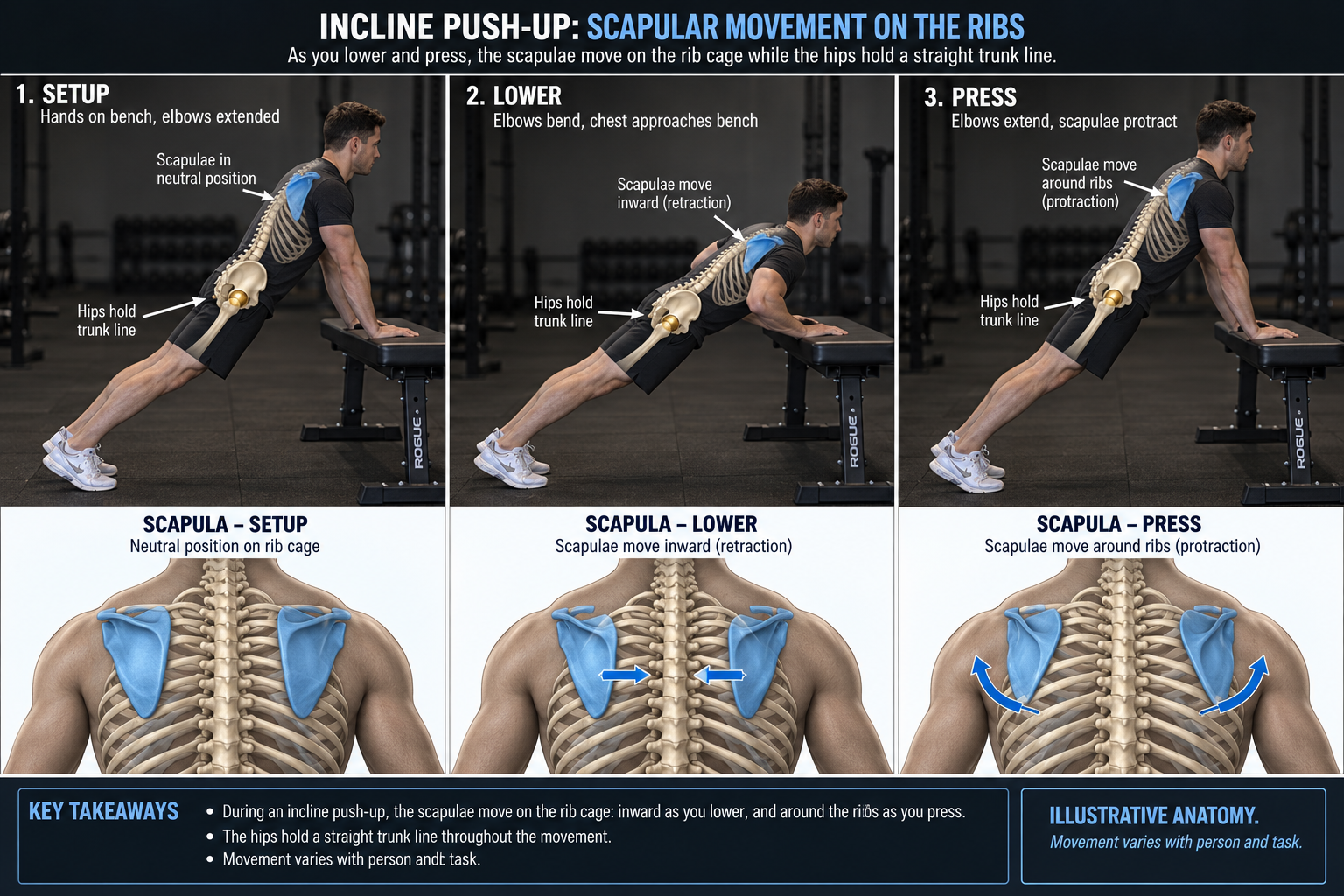
Ivory: rib cage and spine · Gold: hip region · Blue: shoulder-blade region. Illustrative overlays show movement relationships, not measured joint positions. Enlarge chart
Read the chart · hips + shoulder blades
What moves. What supports.
Scapula means shoulder blade. Flexion closes a joint angle; extension opens it. Protraction carries the shoulder blade around the ribs; retraction brings it toward the spine.
1. Find the incline
Hips / pelvis Hold the hips near extension to support the inclined trunk. The body line is controlled, with natural spinal curves.
Scapula / arms Hands stay fixed as the scapulae rest around the ribs. Arm support requires active shoulder-girdle control.
2. Lower
Hips / pelvis Hip angle stays relatively steady while the trunk approaches the bench. A sag or pike changes the task.
Scapula / arms Elbows flex and the scapulae generally move toward the spine relative to the press position. Their three-dimensional motion varies with hand and arm position.
3. Press
Hips / pelvis Maintain the hip and trunk relationship as the body moves away from the bench.
Scapula / arms Elbows extend and the scapulae protract around the ribs. Let them move instead of holding a constant squeeze.
These are typical movement descriptions for the variation shown. A visible landmark does not reveal exact joint motion or establish a diagnosis. Use the chart to explain the task, then compare control and repeatability.
01 / Read the mechanics
In a push-up or free-standing press, the upper arm moves forward/across the torso and the elbow extends. The scapula can protract around the ribs. A bench supports and constrains scapular motion differently.
Read rib-cage position alongside the shoulder blade. Reaching at the end of a push-up is different from forcing a maximal round-back position.
02 / Set up and coach
Choose a wall or bench height that makes the effort manageable.
Press through the whole hand with comfortable wrists.
Let the shoulder blades travel around the ribs as you push away.
03 / Choose a variation
Incline push-up
Adjust the incline to set loading and range.
Wall push-up
Use a lighter starting option for learning scapular travel.
Standing cable press
Explore a single-arm press with a stable stance.
04 / Fit it into the program
Use in the horizontal pressing slot. Match the intended effort before replacing a bench press; the variations are not load-equivalent.
For an initial comparison, change one feature and preserve the planned training volume where practical. Adjust load to the new variation; the same weight can represent a different demand.
05 / Observe and adjust
Shrugging or trunk movement can be task-dependent. Adjust when the athlete cannot control the intended movement or symptoms increase; do not pin the blades down throughout every press.
06 / Retest what matters
Repeat the same incline and hand spacing. Compare controlled repetitions, shoulder comfort, and whether the torso stays organized.
An immediate change is feedback, not proof of a correction. Check repeatability and the athlete’s response at the next session.
Movement education for coaches and athletes. These are general teaching examples, not an individualized rehabilitation plan. Stop a trial that produces new or worsening symptoms. MWK interpretation is labeled separately from the joint-action description.
Study basis: the supplied Week 9 lower-body exercise-selection notes, Week 10 upper-body exercise-selection notes, and MWK Scapular Mechanics & Reaches. Summarized for practical teaching; exercise responses vary by person and task.