1. Build the stance
Hips / pelvis Use a staggered base with enough side-to-side width. Front and rear hips begin at different angles.
Scapula / arms The support-side scapula adjusts to hand contact; use only the support needed for balance.
 MOVEMENT
Lower body · staggered push
Train each leg with a stable, adjustable base.
See it. Then coach it.
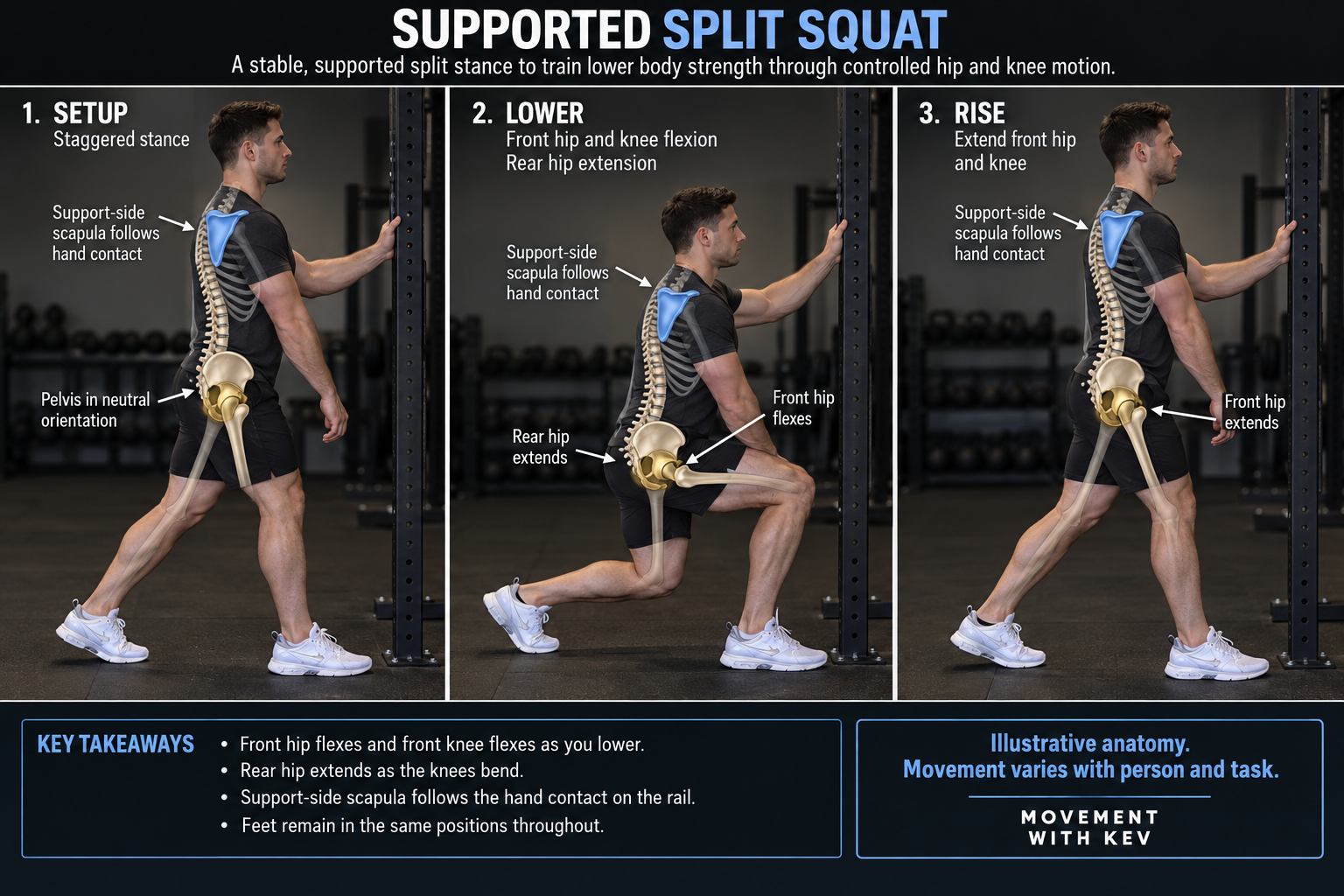
Read the chart · hips + shoulder blades
Scapula means shoulder blade. Flexion closes a joint angle; extension opens it. Protraction carries the shoulder blade around the ribs; retraction brings it toward the spine.
Hips / pelvis Use a staggered base with enough side-to-side width. Front and rear hips begin at different angles.
Scapula / arms The support-side scapula adjusts to hand contact; use only the support needed for balance.
Hips / pelvis The front hip and knee flex. The rear hip is relatively extended while the rear knee bends. Stance length and torso angle change these demands.
Scapula / arms Maintain comfortable rail contact. The shoulder blade follows the supported arm rather than being pinned down.
Hips / pelvis Extend the front hip and knee to raise the body. Both feet contribute; keep their placement repeatable.
Scapula / arms Keep the hand support consistent so a change in upper-body assistance does not disguise the leg response.
These are typical movement descriptions for the variation shown. A visible landmark does not reveal exact joint motion or establish a diagnosis. Use the chart to explain the task, then compare control and repeatability.
The front hip and knee flex during descent and extend on ascent. The rear hip is relatively extended, while the rear knee flexes. Both legs contribute; contribution changes with stance and intent.
Setup reference: the MWK Stacking Guide
A staggered stance adds rotational and balance demands. Pelvic rotation is a variable to observe, not automatic evidence of a fault or a fixed asymmetry.
Use a rack or rail and a comfortable stride.
Reduce depth while maintaining a repeatable stance.
Add a front-held load after the base is consistent.
Fits a unilateral accessory slot. Replace the existing split-squat variation for a trial instead of adding more leg volume.
For an initial comparison, change one feature and preserve the planned training volume where practical. Adjust load to the new variation; the same weight can represent a different demand.
Repeated loss of balance or forced rear-hip stretching suggests changing stride, support, or range. The front knee can travel forward when tolerated.
Repeat on both sides with the same support, stride, and depth. Compare control and tolerance without assuming both sides must look identical.
An immediate change is feedback, not proof of a correction. Check repeatability and the athlete’s response at the next session.
Baseline / task:
One change:
Immediate response:
Next-session response:
Movement education for coaches and athletes. These are general teaching examples, not an individualized rehabilitation plan. Stop a trial that produces new or worsening symptoms. MWK interpretation is labeled separately from the joint-action description.
Study basis: the supplied Week 9 lower-body exercise-selection notes, Week 10 upper-body exercise-selection notes, and MWK Scapular Mechanics & Reaches. Summarized for practical teaching; exercise responses vary by person and task.